FoundationDB reports tens of thousands of simulations nightly and roughly one trillion equivalent CPU-hours. Apple’s CloudKit uses its Record Layer to host billions of independent databases.
01 The thesis
Opportunity should not require a storefront.
Grindz gives neighborhood sellers the infrastructure to be found, trusted, paid, and remembered—without sanding away what makes them local.
Made nearby
Sunday focaccia4 left · pickup 5:00
Small-batch candlescedar · poured today
Garden salsamild · 8 jars
Found nearby
ALReservedexactly once
JMPaidfees disclosed
SKReadypickup protected
A marketplace protocol for food, goods, and whatever neighbors make next.
02 The people
The market is not waiting to be invented.
People already sell from kitchens, garages, pop-ups, group chats, and social feeds. What they lack is a shared spine for availability, trust, payment, and repeat discovery.
30.4million
U.S. nonemployer establishments in 2023.
78.4%of U.S. establishments
$1.75Tin annual receipts
Market backdrop, not Grindz TAM. Source: U.S. Census Bureau, 2023 data.
“Small” describes the org chart. It does not describe the ambition.
For sellersOperate with live inventory, clear fees, safer pickup, and a reputation they own.
For buyersFind what is actually available nearby, know what happens next, and transact with recourse.
For communitiesKeep more commerce local while raising the floor for safety and accountability.
03 The product
One clear path from “I made this” to “I’ll be back.”
Grindz is deliberately versatile about the product and uncompromising about the transaction.
Every step creates an understandable promise for people and a verifiable fact for the system.
-
01
Offer versioned
Publish what is real.
A seller updates the offer, quantity, timing, and pickup terms as life changes.
-
02
Location gated
Discover what is possible.
A buyer sees nearby availability without exposing a private home address.
-
03
Quote immutable
Make the price a promise.
The quote freezes the product, fees, and policy before checkout begins.
-
04
Capacity conserved
Hold without overselling.
Finite inventory moves once—even through retries, timeouts, and duplicate events.
-
05
Trust compounds
Complete with recourse.
Payment, fulfillment, reviews, reports, and enforcement share one accountable history.
04 The proof
We rehearse the bad days before customers have to live through one.
The simulator creates many versions of the future, breaks them on purpose, and checks that buyers and sellers remain protected. It turns “we think this is safe” into evidence anyone can repeat and inspect.
What is the simulator actually doing?
01 · Imagine
Make thousands of tomorrows.
Each world has different buyers, sellers, timing, demand, and failure pressure.
02 · Challenge
Break ordinary moments on purpose.
Two buyers want the last item. A payment reply arrives late. A server restarts halfway through checkout. The same message arrives twice.
03 · Prove
Refuse any future that breaks a promise.
One charge. No oversell. No lost order. If anything goes wrong, its future number reconstructs exactly what happened.
Why this belongs in the investor story
Reliability is capital efficiency.
Grindz coordinates scarce inventory, money, pickup, and reputation. A rare timing bug can become an oversell, a duplicate charge, refunds, support work, and lost trust. Deterministic simulation moves more of that discovery into cheap, repeatable compute—before it becomes an incident.
Production discovers it
Customer harm becomes the test.
Detect, triage, reproduce, remediate, refund, explain, and rebuild trust.
The simulator discovers it
A failed promise becomes a replay seed.
Reproduce exactly, fix the cause, and keep that scenario in every release gate.
Where the technique is used Cloud databases · financial systems · data streaming · distributed SaaS · blockchain networks
A vendor-published customer study estimates 54% less team load per bug. MongoDB says one critical issue reached resolution roughly three weeks faster, preserving time from some of its most expensive engineers.
WarpStream’s deterministic environment caught a race in 233 seconds after tens of thousands of conventional CI hours had missed it. A six-hour run compressed 280 hours of application time.
Published results are directional precedent, not a Grindz savings forecast. MongoDB and WarpStream figures come from Antithesis customer case studies; Apple/FoundationDB figures come from project documentation and a peer-reviewed systems paper. Grindz will measure its own avoided regressions, reproduction time, release confidence, and incident cost.
Also documented in Jane Street’s financial systems and Ethereum’s Merge testing.
Many possible futures0.00 years checked
Moments tested0
Orders completed0
Problems introduced0
Repeat actions caught0
Outdated updates blocked0
Promises broken0
Read the motion
Hover, focus, or tap a symbol to see what it means.One possible future. Each horizontal path is a different tomorrow, with its own timing, demand, and problems.
Promises checked at every moment
Never sell the same item twice
Never charge the same order twice
Only one source decides each order
The same future repeats exactly
Recorded evidence
960 simulated years across 32 universes in one recorded run 2.12M events including 114,000 injected faults 0 promises broken or the run stops and saves the exact futureHow this browser demo relates to the full DST
The live counters are produced by a small Zig kernel compiled to WebAssembly. It inherits the full simulator’s deterministic seed derivation, parameter variation, bounded execution, failure injection, and invariant accounting. The repository DST remains the release-gate authority: it models the complete order saga, event delivery, database crashes, routing epochs, refunds, and failover.
Every browser run can be replayed from its seed. Presentation speed changes; outcomes do not.
05 The model
Fair enough to explain at the door. Strong enough to scale.
The launch model favors supply: the seller pays 2%; the buyer pays 3% + $0.49. A seller can sponsor the buyer fee without changing Grindz’s total yield.
2% seller+3% + $0.49 buyer=5% + $0.49 platform
Live quotehybrid_5_49 · v1
Merchandise$20.00
Buyer service fee$1.09
Buyer pays$21.09
Seller platform fee$0.40
Estimated card processing$0.91
Seller receives$18.69
Grindz gross fee yield$1.49
Seller proceeds
Grindz fee
Processor estimate
Scenario stress test
Completed orders / month10,000
Gross platform fee yield$14,900
GCP planning range$0.5k–$1.2k
Planning model, not a forecast. Gross fee yield is before refunds, incentives, support, fraud, insurance, messaging, verification, tax operations, and other non-GCP costs. Card processing is estimated at 2.9% + $0.30 and borne by the direct-charge seller.
06 The scale
Start as one coherent market. Split only when evidence says to.
Poise makes placement a policy instead of a pile of conditionals. Grindz can stay simple for a pilot, then add independently fenced regional cells without changing the rules buyers and sellers depend on.
PeopleBuyers · sellers · operatorsA clear promise at every interaction
Grindz protocolOffer → quote → hold → pay → fulfill → trustOpenAPI, AsyncAPI, invariants, durable facts
PoiseEligibility · authority · bounded routingWrites never wander. Stale epochs fail closed.
Cell 01Pilot authorityCloud Run · PostgreSQL · Pub/Sub
Cell 02When demand proves itIndependent blast radius
Cell 03When geography earns itSame protocol, new authority
For the businessCost follows demand. No premature fleet of services.
For the marketFailure stays local. One region cannot improvise another region’s writes.
For the teamLocal means honest. The same container and protocols move from a laptop to managed preview.
Open the technical topology
Poise answers where work is eligible to run. The Grindz safety kernels decide whether the work is valid. PostgreSQL remains authoritative inside each cell; an outbox publishes durable facts to projections. Stripe direct charges keep the seller as merchant of record while Grindz collects an application fee.
View the full reference topology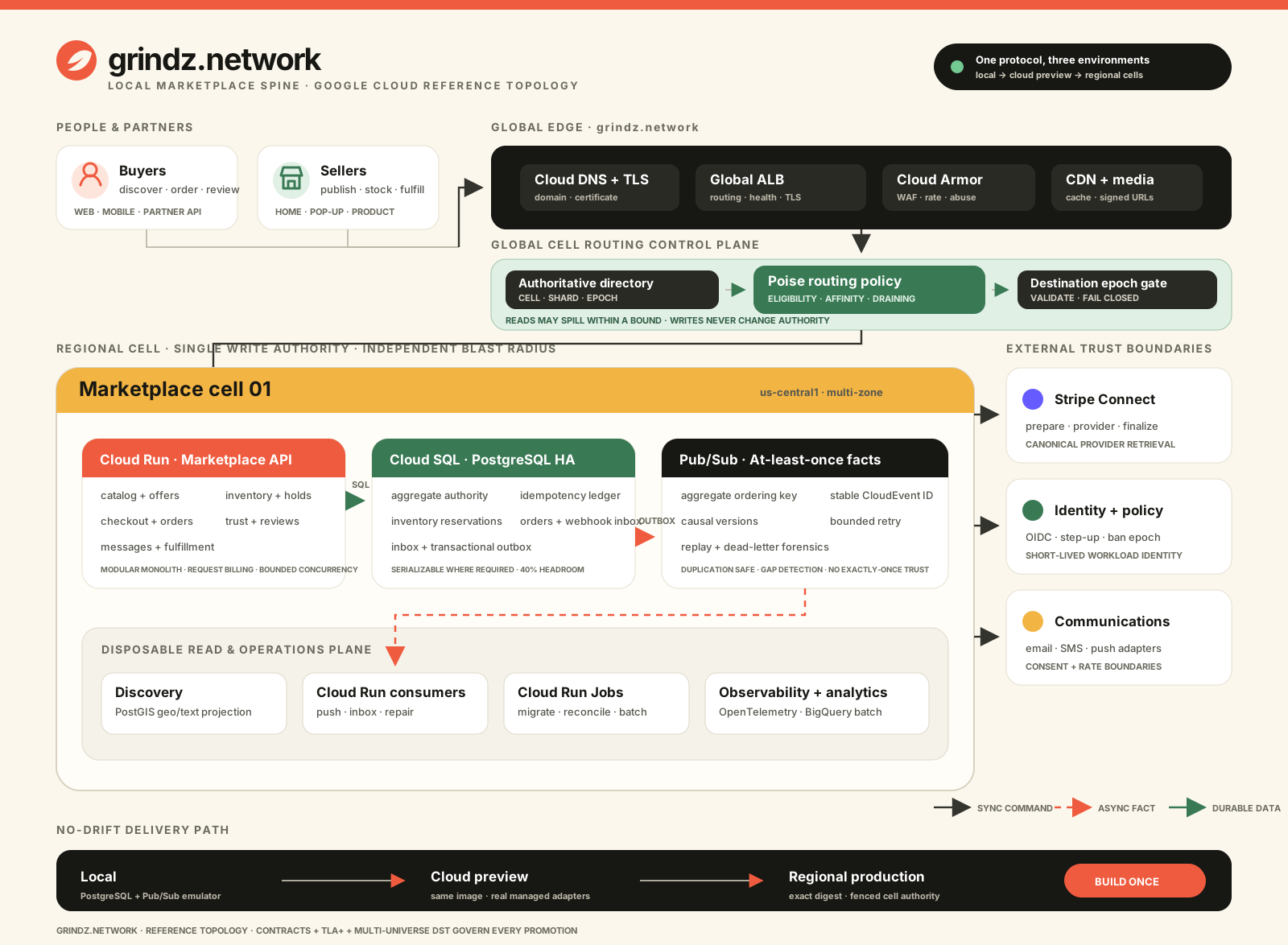
07 The ask
The ask begins where the proof ends.
The core commerce spine is specified, implemented, and tested locally. Capital moves Grindz into managed preview, completes the buyer and seller experiences, and launches one bounded pilot. It does not fund the discovery of first principles.
We are looking for
Aligned capital. Fund product, trust, and operations—not a rewrite of the foundation.
One pilot market. Give the proof a real, bounded environment in which to earn trust.
Operating partners. Bring sellers, policy expertise, and community knowledge close to every decision.